Pragjyotishpur: Assam before Assam
Assam is widely known across India as the abode of Goddess Kamakhya, the embodiment of feminine force, desire, and procreation.
After nearly two months of relentless campaigning, high-decibel rallies, and fierce narrative battles, the electoral marathon has entered its most dramatic phase.




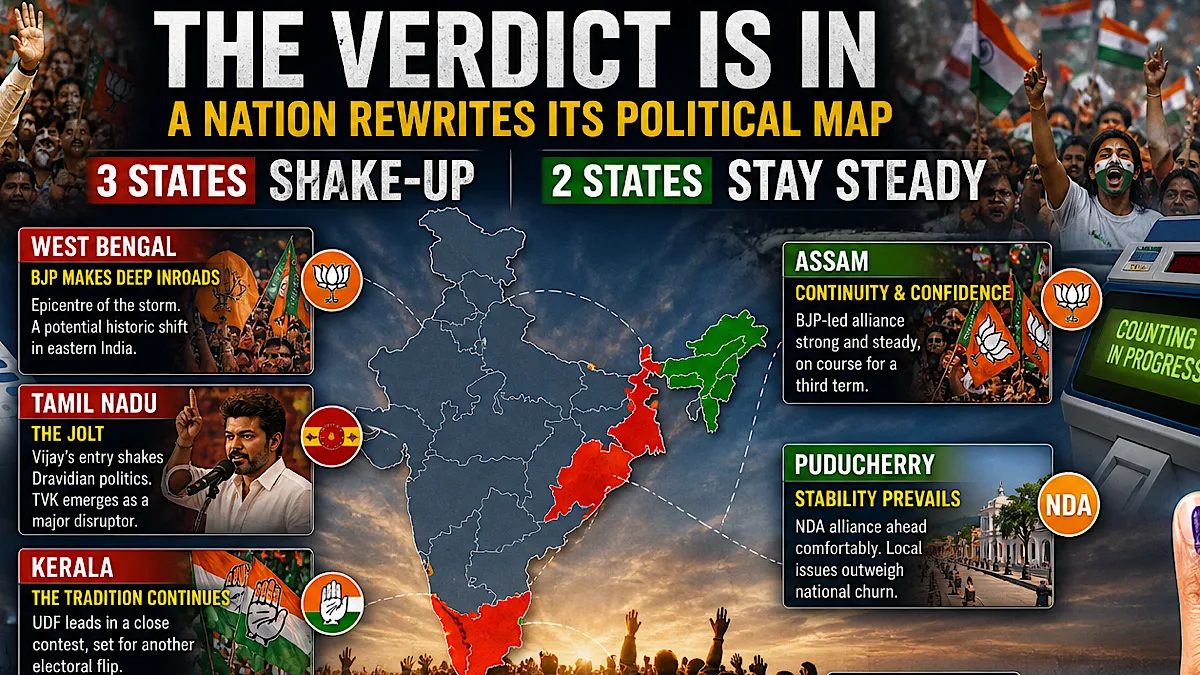
Photo:AI
After nearly two months of relentless campaigning, high-decibel rallies, and fierce narrative battles, the electoral marathon has entered its most dramatic phase. The emerging verdict is explosive: a sweeping shake-up of power in three states, even as Assam and Puducherry defy the churn and hold steady.
At daybreak, counting centres transformed into fortress-like command hubs, marked by tight security and intense scrutiny. Postal ballots offered the first clues, but it was the steady stream of Electronic Voting Machine (EVM) rounds that began shaping the real narrative. Within hours, screens flickered with volatile leads—swinging, tightening, and eventually tilting decisively—signalling a political realignment that can no longer be ignored.
Advertisement
West Bengal has emerged as the epicentre of this unfolding storm. A state long synonymous with fierce electoral contests is once again living up to its reputation—this time with potentially historic consequences. Early trends show the BJP making deep inroads across key constituencies, while the Trinamool Congress mounts a determined defence. A shift here would not merely change a government; it could redraw the ideological contours of eastern India, turning a long-standing stronghold into a new battleground of national politics.
Advertisement
If Bengal is the clash, Tamil Nadu is the jolt. The dramatic political entry of actor-turned-politician Vijay has disrupted the predictability of Dravidian politics, injecting volatility into a system long dominated by the DMK and AIADMK. Early trends point to a fractured mandate, with his Tamilaga Vettri Kazhagam emerging as a serious disruptor. This is more than an electoral contest—it reflects a generational churn, where charisma-driven politics collides with entrenched party structures.
Kerala, true to its political DNA, appears poised for yet another familiar flip. The state’s tradition of alternating power seems to be playing out once again, with early leads nudging the Congress-led UDF ahead in a tightly contested race. If sustained, it will reinforce Kerala’s unique electoral culture, where change is almost institutionalised.
Amid this tide of upheaval, Assam tells a different story—one of consolidation and continuity. The BJP-led alliance, aiming for a third consecutive term, is holding its ground with confidence. Current trends suggest that its political messaging and organisational strength remain intact, effectively countering anti-incumbency currents visible elsewhere.
Puducherry mirrors this stability. The NDA alliance maintains a comfortable lead, indicating that local dynamics and governance narratives are outweighing broader national trends. In a contest shaped largely by micro-level factors, the Union Territory appears firmly on course for continuity.
The scale of this electoral exercise underscores its significance. With over 160 million voters deciding the fate of 824 seats, this is far more than a routine state election—it is a massive democratic churn with far-reaching national implications. The outcomes are likely to influence political momentum, alliances, and strategies well beyond state borders.
Beyond the numbers lies a deeper story: a restless electorate in some regions demanding change, while others signal a preference for stability. New political forces are challenging established orders, regional identities are reasserting themselves, and India’s political map is being redrawn in real time.
As counting progresses and leads solidify into victories, the message is unmistakable: the electorate is rewriting the rules—delivering regime change in three states while drawing a firm line in Assam and Puducherry.
Advertisement